If you're planning a bathroom renovation and working with a compact space, you're not alone. Many Australian homes, particularly older Queenslanders, Federation-style houses, and inner-city apartments, come with bathrooms that feel more like a cupboard than a sanctuary. The good news? With the right design choices, even the smallest bathroom can feel open, light, and luxurious.
Here are seven tried-and-tested ways to make your small bathroom feel much bigger than it actually is.
Colour is one of the most powerful tools in any renovation. Light, neutral tones such as soft white, warm cream, pale grey, or sand reflect natural and artificial light around the room, instantly making the space feel more open and airy.
The trick is to keep the palette consistent across walls, floor, and even the cabinetry. When the eye doesn't have to "stop" at a strong colour contrast, the room feels seamless and larger. Tiling your walls in the same tone as your floor is a particularly effective technique that's become increasingly popular in Australian bathroom design.
If you want to add personality, do it through textures and finishes rather than bold colours. A matte wall tile paired with a polished floor tile in the same hue gives depth without visual clutter.
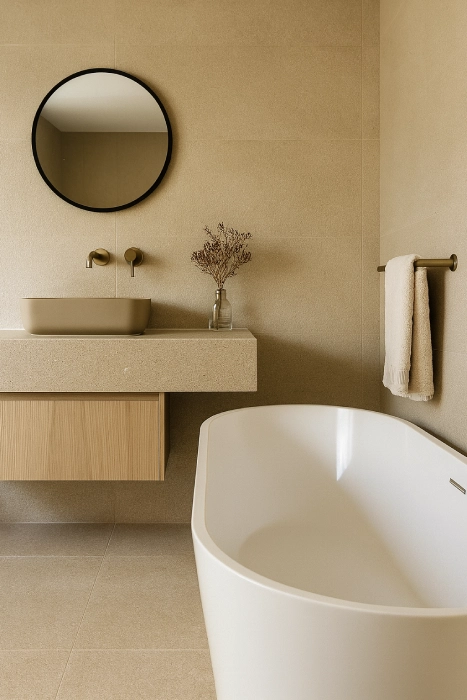
Image: Royal tiles
It might seem counterintuitive, but larger tiles actually make a small bathroom feel bigger. Fewer grout lines mean less visual noise, and the eye can travel across the floor more freely.
Rectified tiles (those with very fine, tight grout joints) in a 600x600mm or larger format are a great choice for compact Australian bathrooms. Laying them on a diagonal can also add a sense of width to a narrow room.
Continuing the floor tile up the lower portion of the wall is another clever trick that blurs the boundary between surfaces and stretches the perceived space.
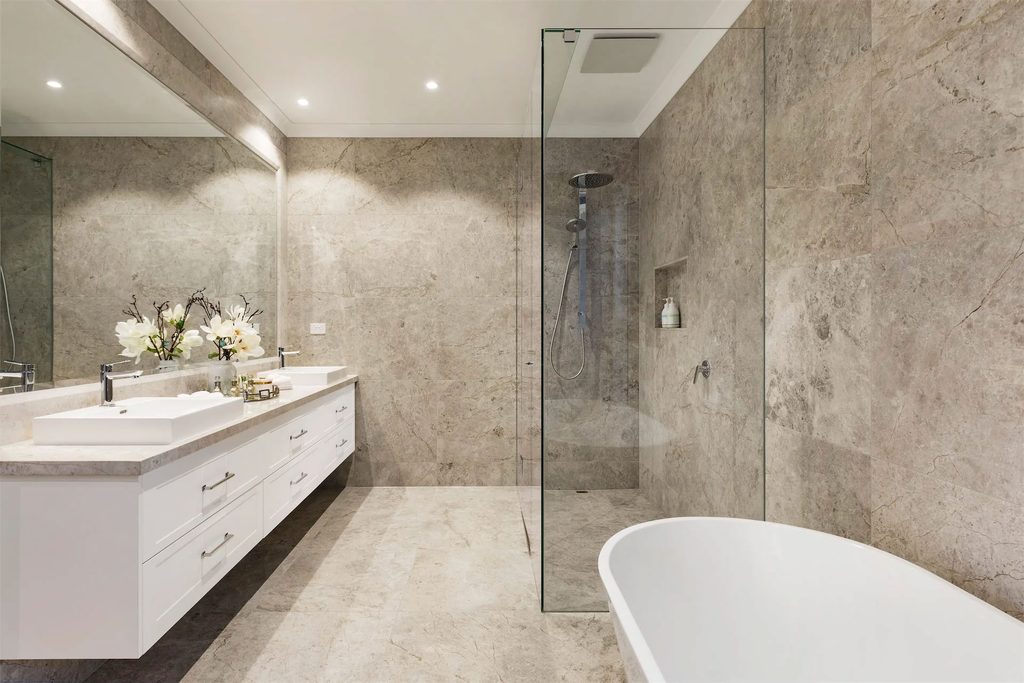
Image: Royal Tiles
Mirrors are a non-negotiable in a small bathroom. A generous mirror, or better yet a full mirror wall above the vanity, reflects light and creates the illusion of depth. It essentially doubles what the eye sees, making the room feel twice the size.
For Australian bathrooms, frameless mirrors or those with a slimline frame tend to work best as they don't add visual weight to the space. You can also consider mirrored shaving cabinets, which give you practical storage at the same time.
If your bathroom has a window, position the mirror to reflect that natural light back into the room for maximum effect.
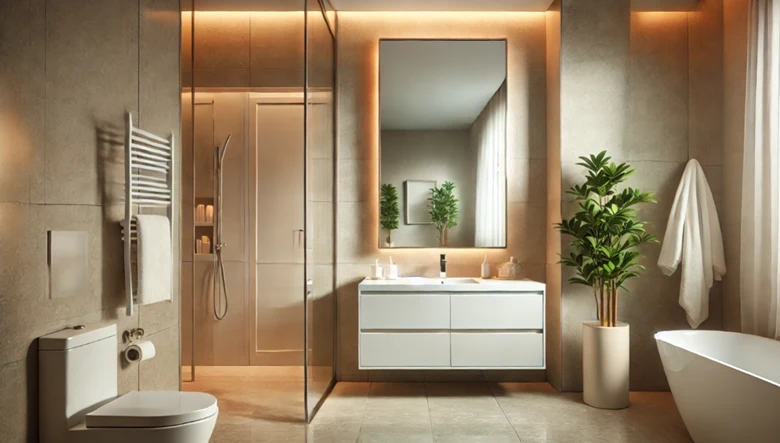
Image: Bargain For You
A dark bathroom always feels smaller than it is. Natural light is ideal, so if your renovation allows for it, consider enlarging an existing window or adding a skylight. Frosted glass keeps privacy intact while letting in plenty of Queensland sunshine or that soft Sydney morning light.
When natural light is limited, layered artificial lighting makes a real difference. Rather than relying on a single overhead downlight, combine:
This layered approach eliminates dark corners, which are the enemy of a spacious-feeling bathroom.
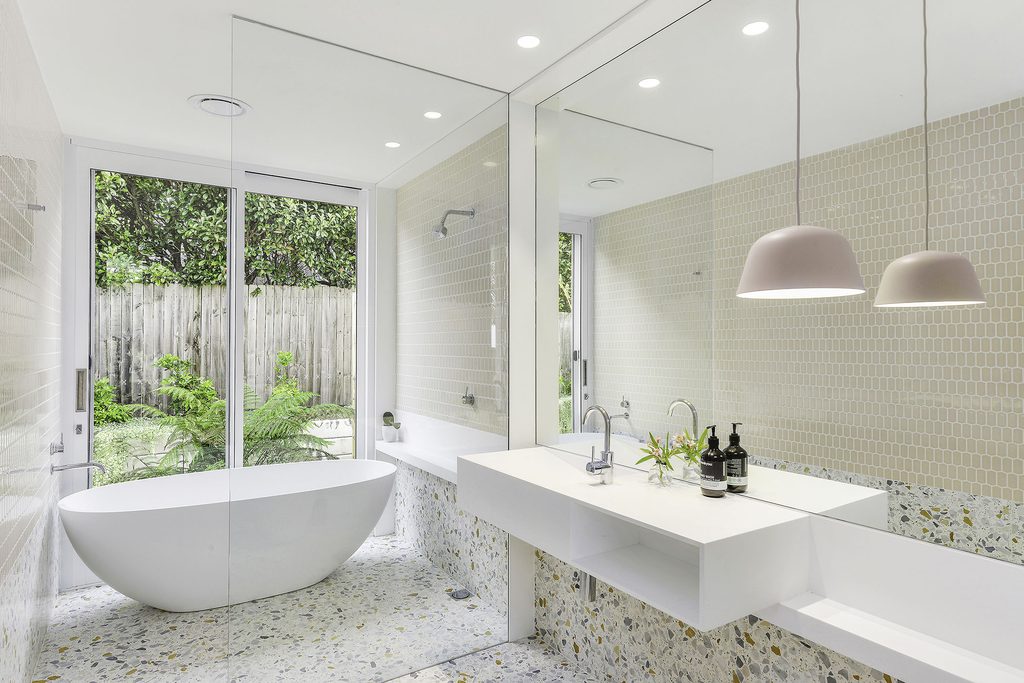
Image: Custom Home Builder Central Coast, Sanders Construction Project.
Wall-mounted or floating vanities are one of the best investments you can make in a small bathroom renovation. By lifting the cabinetry off the floor, you expose more of the floor surface, which makes the room feel significantly larger.
The continuous run of floor tile visible beneath the vanity draws the eye outward and creates a sense of breathing room that a floor-standing vanity simply cannot achieve.
As a bonus, a floating vanity is also much easier to mop around. Practical and good-looking: a win-win for any Australian homeowner.
When choosing your vanity, keep the profile sleek. Handleless drawers with push-to-open mechanisms look especially clean and are a popular choice in contemporary Australian bathroom design.
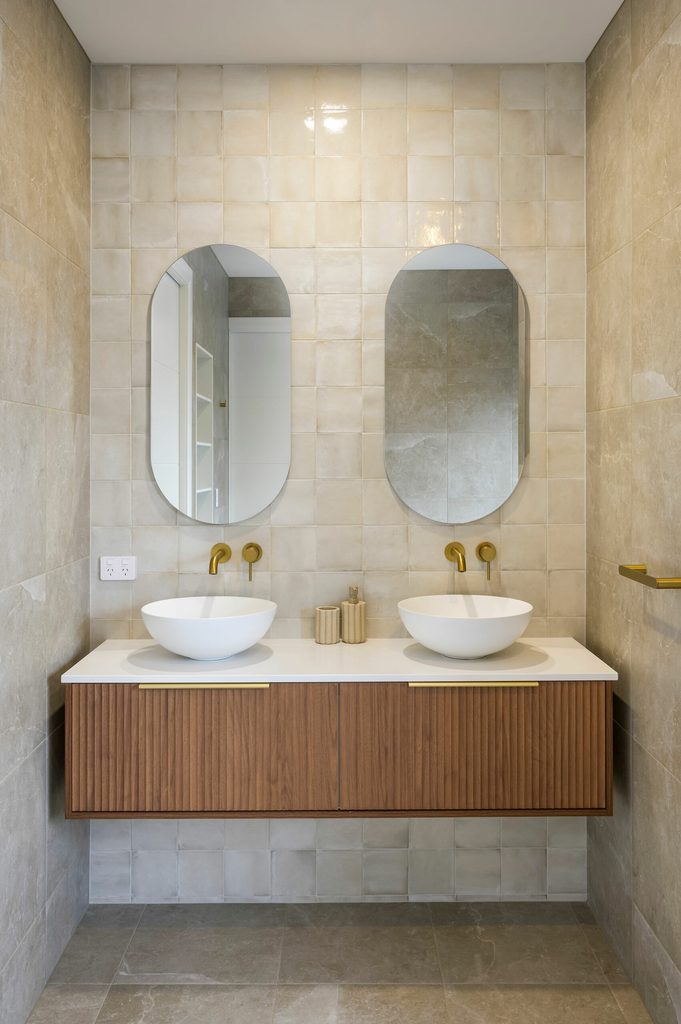
Image: Maitland Builder, P&D Kay Constructions.
One of the biggest mistakes in small bathroom design is using a framed shower screen or a solid shower curtain. These elements visually divide the room in two, cutting the perceived floor space almost in half.
A frameless glass shower screen, on the other hand, allows the eye to travel through the entire bathroom uninterrupted. A fully tiled walk-in shower with no screen at all is even better if your layout allows for it.
When selecting your shower tiles, continue the same tile used elsewhere in the bathroom to keep the look unified. This is a technique used widely by Australian bathroom designers to make compact wet areas feel cohesive and open.
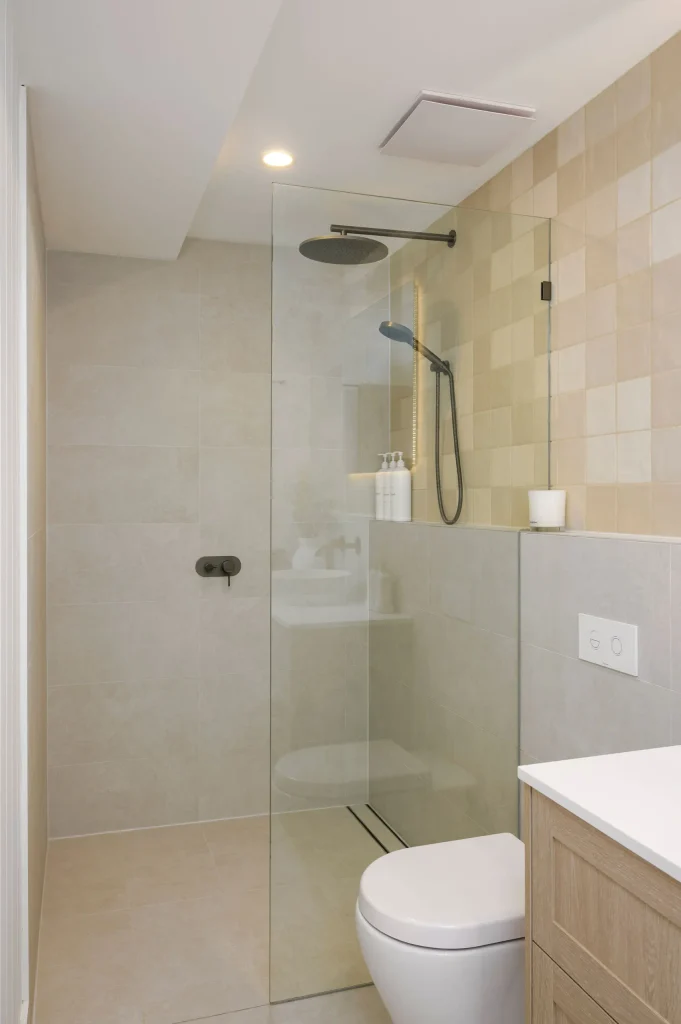
Image: Central Coast Builder, McCamley Constructions.
No matter how well-designed your bathroom is, clutter will make it feel small and chaotic. During your renovation, prioritise clever built-in storage solutions so that benchtops and surfaces stay clear.
Some practical ideas include:
A bathroom where everything has a home feels calm and open. It is also much more enjoyable to use every single day, which is ultimately the point of a great renovation.
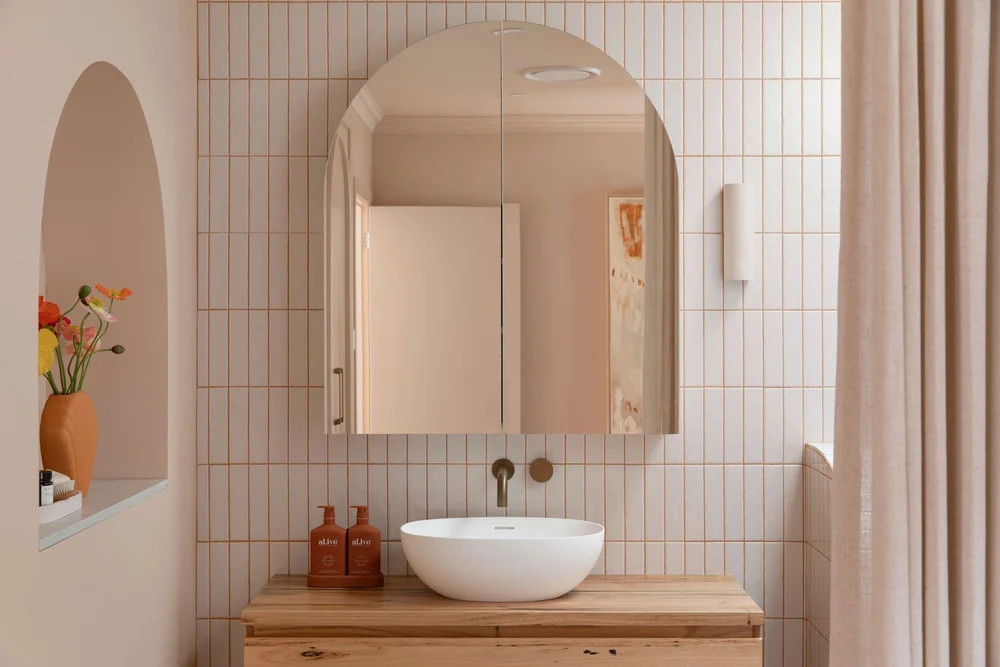
Image: Three Birds Renovations
Do not forget the vertical dimension. Drawing the eye upward makes ceilings feel higher and the room feel more spacious overall. Tall, narrow shelving, vertical tile layouts, and floor-to-ceiling cabinetry all create this effect. Even a simple stack bond tile pattern (where tiles are laid in a straight vertical line rather than a brick offset) can subtly elongate a room.
Transforming a small bathroom does not require knocking down walls or a massive budget. By making smart choices around colour, tiles, lighting, fixtures, and storage, you can create a bathroom that feels generous, calm, and beautifully designed, regardless of its size.
Whether you are working with a tiny ensuite in a Sydney apartment or a narrow main bathroom in a Melbourne terrace home, these principles will help you get the most out of every square metre.